

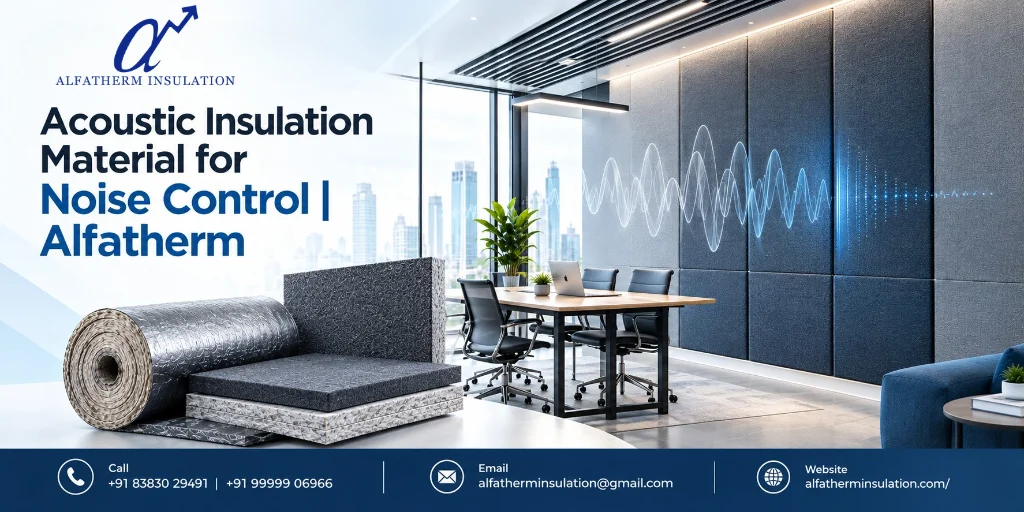
Acoustic Insulation Material for Noise Control | Alfatherm
Acoustic Insulation Material: A Complete Guide to Noise Control
Acoustic Insulation Material is a common challenge in homes, offices, commercial buildings, and industrial facilities. Traffic, conversations, machinery, and neighbouring rooms can affect comfort, privacy, and productivity. Choosing the right acoustic insulation material can help control unwanted sound and create a more comfortable indoor environment.
Alfatherm Insulation helps customers explore insulation solutions for different building and industrial requirements. Before choosing a product, it is important to understand how acoustic insulation works, which materials are available, and what factors influence sound-control performance.
What Is Acoustic Insulation Material?
An acoustic insulation material is designed to absorb sound energy or reduce the transmission of sound between spaces. Depending on its properties and installation, it may be used inside walls, ceilings, partitions, floors, and equipment enclosures.
Sound absorption and sound insulation serve different purposes. Sound absorption reduces reflections within a room, helping control echo and reverberation. Sound insulation aims to limit the amount of sound travelling from one space to another.
For example, a conference room may require sound-absorbing surfaces for clearer conversations, while a bedroom beside a busy road may need a wall and window system designed to reduce incoming noise. The correct solution depends on the source of the sound and the desired outcome.
Why Is Acoustic Insulation Important?
Installing a suitable acoustic insulation material can improve the comfort and usability of different indoor spaces. Its effectiveness depends on product specifications, installation quality, and the overall building structure.
1. Improved comfort: Noise reduction can make bedrooms, living rooms, offices, and meeting areas more pleasant to use.
2. Better concentration: Controlled noise levels can help employees, students, and professionals focus on their tasks.
3. Greater privacy: Properly designed walls, partitions, and ceilings can help reduce conversations travelling between adjoining rooms.
4. Clearer communication: Sound-absorbing surfaces can reduce excessive reverberation, making speech easier to understand.
5. Industrial noise management: Appropriate insulation systems and acoustic enclosures can help control noise generated by machinery and mechanical equipment.
For the best results, consider the entire building assembly. Gaps around doors, windows, service openings, and wall junctions can allow sound to bypass insulated areas.
Types of Acoustic Insulation Materials
Different materials offer different combinations of sound absorption, thermal performance, density, and fire-related characteristics. The most suitable option depends on the application and the product’s technical specifications.
- Glass Wool Insulation
Glass wool is manufactured from fine glass fibres that form a porous structure. It is commonly considered for wall cavities, suspended ceilings, partitions, and building services applications. Its fibrous structure can absorb sound energy while also providing thermal insulation.
Glass wool products are available in different thicknesses and densities. Check the manufacturer’s technical information to determine whether a particular product meets the project’s acoustic and installation requirements. - Mineral Wool and Rockwool Slabs
Mineral wool and Rockwool slabs are fibrous insulation products used in building and industrial applications. Suitable products can help absorb sound and may provide additional thermal or fire-performance benefits, depending on their specifications.
They may be considered for partitions, plant rooms, ceilings, and equipment enclosures. Before selecting a product, review its density, thickness, operating-temperature limits, and intended application. - Resin-Bonded Mineral Wool Slabs
Resin-bonded mineral wool slabs use a binding system to hold mineral fibres together. Their physical properties make them potential options for selected insulation assemblies where sound absorption and other performance requirements must be considered.
The correct specification depends on the installation location, mounting arrangement, facing, and compatibility with surrounding construction materials. - Acoustic Panels and Ceiling Systems
Acoustic panels and ceiling systems help control reflected sound within enclosed spaces. They are frequently considered for offices, conference rooms, classrooms, studios, and auditoriums
Performance depends on the panel’s design, thickness, surface characteristics, installation method, and coverage. Decorative panels should not be selected on appearance alone; acoustic test data provides a more reliable basis for comparison. - Combined Wall and Ceiling Assemblies
Some projects require several components rather than a single product. A complete assembly may include cavity insulation, wallboards, resilient mounting components, sealed joints, and carefully designed openings.
This approach can be important when reducing sound transmission between rooms. Structural connections and unsealed gaps can create alternative paths for sound, limiting the performance of an otherwise suitable insulation system.
How to Choose the Right Acoustic Insulation
Selecting an acoustic insulation material starts with identifying the source of noise and the performance required. Different solutions may be needed for traffic, conversations, machinery, vibration, and reverberation.
Application: Identify whether the product is intended for a home, office, auditorium, partition, ceiling, or industrial facility.
Acoustic performance: Review relevant sound absorption or sound transmission ratings for the proposed application.
Thickness and density: Confirm that the product fits the available cavity or installation space.
Fire and thermal requirements: Check whether the project requires additional thermal insulation or specified fire performance.
Installation conditions: Consider moisture exposure, structural support, ventilation, and compatibility with other materials.
Budget: Compare product costs, installation expenses, maintenance requirements, and expected service life.
A supplier can help identify suitable options, but the final selection should be based on technical documentation and the requirements of the building or facility.
Applications of Acoustic Insulation
Residential properties may use insulation systems to improve comfort between bedrooms, living areas, and adjoining rooms. In these projects, walls, doors, windows, and joints all influence the final result.
Commercial buildings may require acoustic treatment in offices, meeting rooms, reception areas, and shared workspaces. Schools, hospitals, studios, and auditoriums can also benefit from appropriately designed sound-control systems.
Industrial facilities face additional challenges from machinery, compressors, and mechanical services. Before installing an acoustic insulation material in these environments, assess operating temperatures, equipment access, ventilation, and applicable safety requirement

Why Consider Alfatherm Insulation?
Alfatherm Insulation provides insulation-related solutions for building and industrial applications. Customers can discuss their project requirements and enquire about suitable products for their intended installation.
When contacting a supplier, explain the noise problem, installation location, available space, and any thermal or fire-performance requirements. Request technical data sheets to compare product characteristics and confirm suitability before purchasing.
Choosing an appropriate product and following the recommended installation method can help avoid unnecessary costs and improve the performance of the overall insulation system.
Common Mistakes to Avoid
One common mistake is assuming that every insulation product provides the same acoustic performance. Different materials and assemblies serve different purposes, so specifications should always be reviewed.
Another mistake is overlooking gaps around doors, windows, pipes, and service openings. Even a suitable acoustic insulation material may deliver limited results when sound can travel through unsealed areas.
It is also important to distinguish between reducing echo and limiting sound transmission. A room with acoustic panels may have less reverberation without being fully isolated from outside noise. Identify the main problem before selecting a solution.
Conclusion
Selecting the right acoustic insulation material can help create quieter, more comfortable, and more functional spaces. Glass wool, mineral wool, Rockwool slabs, acoustic panels, and combined wall systems offer different benefits depending on the application.
For reliable results, assess the noise source, compare technical specifications, and ensure that the complete assembly is designed and installed appropriately. Contact Alfatherm Insulation to discuss your requirements and explore available insulation solutions.
Contact Alfatherm Insulation
-
Phone: +91 83830 29491 / +91 99999 06966
-
Email: alfatherminsulation@gmail.com
-
Website: https://alfatherminsulation.com/

0 comments