
Mineral Wool vs Fiberglass Insulation: Which Is Better?
Mineral Wool vs Fiberglass Insulation: Benefits, Differences and Uses
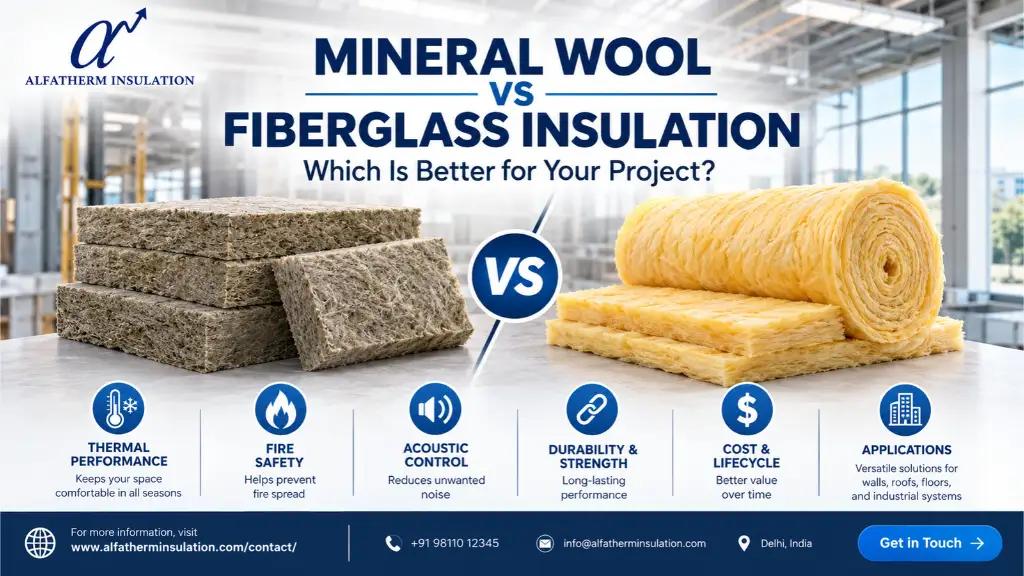
Choosing the right insulation can improve indoor comfort, reduce heat transfer and help control noise. When comparing Mineral wool vs Fiberglass Insulation, the best choice depends on your building, temperature requirements, fire safety needs, acoustic performance and budget. Both materials are widely used in residential, commercial and industrial projects, but each has different features.
Alfatherm Insulation offers mineral wool, fiberglass wool and other insulation products for different applications.
This guide explains their main differences to help you make an informed decision.
What Is Mineral Wool Insulation?
Mineral wool is a fibrous insulation material made from molten rock, minerals or industrial slag. It is processed into fine fibres and supplied in forms such as slabs, rolls, mattresses and pipe sections.
Mineral wool is known for thermal insulation, sound absorption and fire performance. Many grades are non-combustible, making them suitable for applications where fire safety is important. However, the exact performance depends on the product specifications.
Mineral wool is commonly used in industrial equipment, HVAC ducts, walls, roofs, ceilings, tanks and partitions. It can help reduce heat loss and improve acoustic comfort when properly selected and installed.
What Is Fiberglass Insulation?
Fiberglass insulation, also called glass wool, is manufactured from fine glass fibres. These fibres trap air and slow the movement of heat through building surfaces.
It is available in rolls, batts, slabs and other formats. Fiberglass is commonly used in residential buildings, commercial spaces, ceilings, partition walls and air conditioning systems.
When comparing Mineral wool vs Fiberglass Insulation, fiberglass is often preferred for its lightweight structure, flexibility and ease of installation. Its thermal performance depends on thickness, density, installation quality and the specific product grade.
Mineral Wool vs Fiberglass Insulation: Key Differences
Both materials can improve building efficiency, but their characteristics make them suitable for different requirements.
| Feature | Mineral Wool | Fiberglass |
|---|---|---|
| Raw material | Rock, minerals or slag | Glass fibres |
| Thermal insulation | Depends on thickness and grade | Depends on thickness and grade |
| Fire performance | Many grades are non-combustible | Varies by product |
| Sound absorption | Often excellent | Good in suitable assemblies |
| Weight | Often denser | Generally lightweight |
| Available forms | Slabs, rolls, mattresses and pipe sections | Rolls, batts and slabs |
| Common applications | Industrial insulation, ducts and partitions | Walls, ceilings and HVAC |
| Cost | Varies by specification | Often economical |
Neither material is automatically the best for every project. Compare their technical specifications, intended applications and installation requirements before purchasing.

Which Material Provides Better Thermal Insulation?
Both materials reduce heat transfer by trapping air within their fibres. Their insulating performance depends on thermal conductivity, thickness, density and installation quality.
For example, roof insulation can help reduce unwanted heat entering a building during summer. Wall insulation can help maintain comfortable indoor temperatures throughout the year.
When evaluating Mineral wool vs Fiberglass Insulation, compare the declared thermal conductivity or R-value at the required thickness. Also consider air leakage, thermal bridges and moisture conditions.
Correct installation is essential because gaps and compression can reduce insulation performance. A suitable material combined with proper installation can improve energy efficiency and help manage heating and cooling costs.
Which Material Is Better for Fire Safety?
Fire performance is an important consideration in factories, warehouses, commercial buildings and industrial facilities.
Many mineral wool products use non-combustible fibres and are selected for applications requiring strong fire performance. However, the complete assembly, including facings, joints and fixings, must meet the applicable requirements.
Fiberglass products also have different fire ratings depending on their composition and facing materials. Therefore, buyers should check technical data sheets and relevant test certificates before making a decision.
For high-temperature industrial equipment, always select insulation specifically designed for the operating conditions.
Which Material Offers Better Sound Insulation?
Both materials can absorb sound and help reduce noise within suitable building assemblies.
Mineral wool is frequently used in acoustic partitions, auditoriums, equipment enclosures and industrial facilities. Its density and fibre structure can support effective sound absorption.
Fiberglass can also provide useful acoustic performance in ceilings, internal walls, studios and HVAC systems.
When comparing Mineral wool vs Fiberglass Insulation, remember that sound insulation depends on the complete structure. Wall layers, gaps, framing and vibration transmission also influence the final result.
Where Can These Insulation Materials Be Used?
Mineral wool is suitable for many industrial and building applications, including:
Industrial ducts, tanks and equipment.
Roofs, walls and partition systems.
Acoustic enclosures and noise-control applications.
Selected high-temperature insulation systems.
Fiberglass insulation is commonly used for:
Residential and commercial walls.
Roofs, ceilings and internal partitions.
Air conditioning and ventilation ducts.
Building projects requiring lightweight insulation.
The final selection should consider the temperature range, moisture exposure, available space and required performance.
What Should You Check Before Buying Insulation?
Before selecting an insulation material, review these important factors:
Application: Identify whether the product is required for a wall, roof, duct, pipe or industrial system.
Thickness: Choose suitable dimensions according to thermal and acoustic requirements.
Density: Confirm the appropriate density for the intended application.
Fire rating: Verify product performance where fire safety is important.
Moisture protection: Check whether protective facings or vapour-control layers are required.
Installation: Follow the manufacturer’s instructions and use appropriate protective equipment.
Budget: Compare products with similar specifications rather than price alone.
Fibrous insulation can irritate the skin, eyes and respiratory tract during handling. Follow the manufacturer’s safety guidance and wear suitable protective equipment.
Why Choose Alfatherm Insulation?
Alfatherm Insulation supplies insulation materials, including mineral wool, fiberglass wool, rock wool products and resin-bonded slabs. Its product range serves various building, acoustic and industrial requirements.
Customers comparing Mineral wool vs Fiberglass Insulation can contact the team to discuss the intended application, required thickness, operating temperature and quantity.
Review the available specifications before ordering to ensure the selected product suits your project.
Contact Alfatherm Insulation
For information about mineral wool, fiberglass wool and other insulation materials, contact Alfatherm Insulation.
Phone: +91 83830 29491 / +91 99999 06966
Email: alfatherminsulation@gmail.com
Address: 5272 (M.F.), Main Shradhanand Marg, Ajmeri Gate, Delhi – 110006
Soical Media: Alfatherm Insulation
Conclusion
Mineral wool And Fiberglass Insulation are useful insulation materials with different strengths. Mineral wool is often preferred where non-combustibility, acoustic performance or industrial requirements are important. Fiberglass is widely used in building cavities, ceilings and HVAC systems because of its lightweight and flexible formats.
The right choice in Mineral wool vs Fiberglass Insulation depends on verified product specifications, safety requirements, installation conditions and total project cost.
Contact Alfatherm Insulation to discuss your requirements and identify a suitable insulation solution.

0 comments